
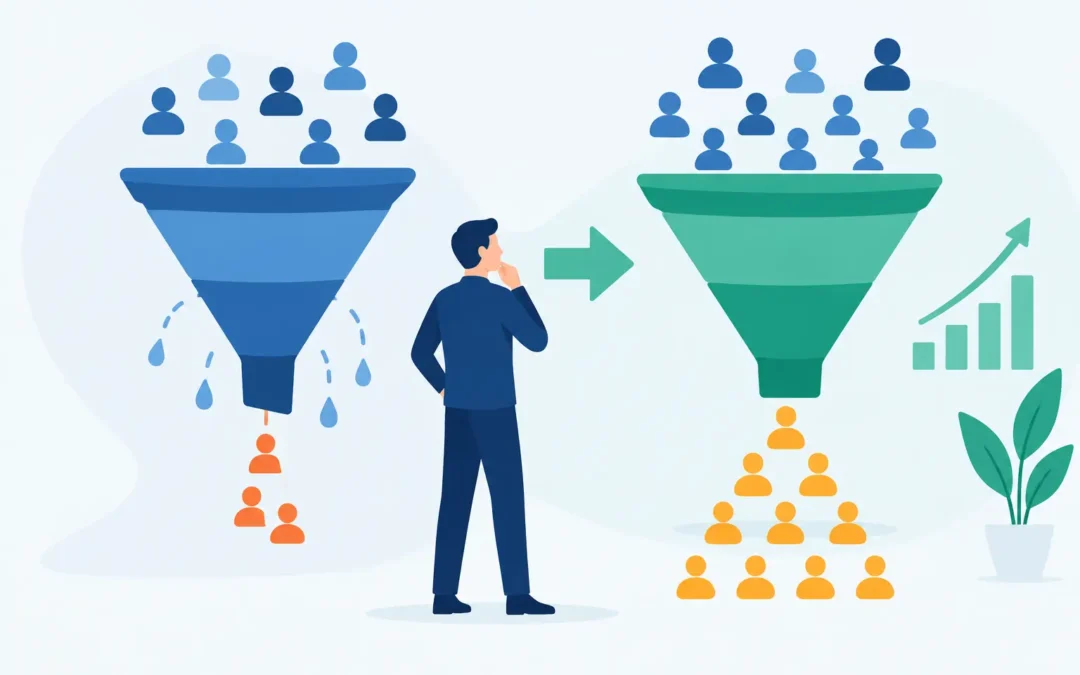
A lead can look qualified on a spreadsheet and still produce zero revenue. That is why asking what causes low lead conversion is more useful than blaming the source, the sales team, or the market. Low conversion is usually a breakdown between demand generation, contact strategy, sales execution, and measurement.
For agencies, call centers, and high-volume sales teams, the cost of that breakdown compounds fast. A campaign that produces 1,000 leads with weak response times or poor routing does not just waste media spend. It burns rep capacity, lowers morale, distorts reporting, and pushes customer acquisition cost higher.
What Causes Low Lead Conversion?
The short answer is misalignment. The lead’s intent, the offer, the contact process, and the salesperson’s next step are not working together. Fixing one part of the funnel while ignoring the rest can improve activity without improving revenue.
The strongest operators diagnose conversion in stages: lead delivered, first contact attempt, live conversation, qualified opportunity, application or appointment, and closed customer. Every stage needs a clear definition. Without one, teams call leads “bad” when the real problem is that nobody reached them quickly enough or followed up long enough.
The lead does not match the sales motion
Not every lead product belongs in every funnel. A consumer who asks for information may be a workable prospect for a consultative sales process with fast follow-up. That same person may not convert through a high-pressure, one-call close. Likewise, aged data can support a disciplined outbound campaign, but it should not be measured by the same expectations as an exclusive real-time inbound transfer.
This is where many buyers lose money. They purchase based on price per lead, then apply a sales motion designed for a completely different level of intent. The result is predictable: low contact rates, poor qualification, and a team convinced the vendor failed.
Start by matching the source to the desired outcome. If speed and immediate intent drive your economics, live transfers or real-time leads may justify a higher upfront cost. If your organization has strong dialing capacity, proven scripts, and follow-up discipline, targeted data or aged leads may produce a lower cost per acquisition. The right answer depends on your infrastructure, not just your media budget.
Speed to contact is killing workable opportunities
In competitive verticals such as insurance, funding, debt relief, mortgage, and solar, prospects often submit multiple inquiries in minutes. The first capable company to make meaningful contact has an advantage. Waiting an hour, much less until the next business day, turns a fresh hand-raise into a cold outbound call.
Fast response means more than an automated text. A confirmation message can help, but the goal is a live conversation while the prospect remembers why they inquired. If inbound leads arrive after hours, the campaign needs a real plan for that reality: extended coverage, immediate SMS engagement, a scheduled callback system, or a channel that only runs when reps can respond.
Measure median speed to first human contact, not just whether a lead was called eventually. Averages can hide a major operational problem. Ten leads called immediately and ten leads called six hours later may produce an average that looks acceptable while half the opportunity has already decayed.
Routing delays and ownership gaps create silent lead loss
A qualified prospect cannot convert if the lead sits unassigned, lands with the wrong team, or gets passed between departments. Complex routing rules often create friction disguised as process. Territory restrictions, language requirements, licensing rules, product eligibility, and capacity caps all matter, but they need to be managed in real time.
Look for leads with no first disposition, repeated transfers, or long gaps between assignment and first outreach. Those records reveal where pipeline is leaking. A clean routing setup assigns a clear owner, prioritizes fresh opportunities, and reroutes quickly when a rep is unavailable.
Lead buyers should also verify that the delivery method fits the operation. A real-time lead sent by email only may not be operationally real-time. A transfer call delivered to a queue with long hold times can lose the prospect before the sales conversation begins. Lead Flow Partners works across lead formats because the delivery mechanism has to support the conversion model, not simply fulfill a volume target.
Sales follow-up ends too early
One call and one email are not a follow-up system. Inbound prospects get busy, screen unknown numbers, compare options, and delay decisions. That does not automatically mean they lack intent.
The right cadence varies by vertical and compliance requirements, but the principle is constant: use multiple attempts, multiple channels, and a useful reason to reengage. Calls, compliant SMS, email, voicemail, and scheduled callbacks should work as one sequence. Every touch should make the next action easy, whether that is completing an application, confirming eligibility, booking a consultation, or speaking with a specialist.
Poor follow-up also creates false lead-quality conclusions. If one team makes eight disciplined attempts over several days and another makes two calls before dispositioning the lead as dead, their conversion reports cannot be compared fairly. Before replacing a source, audit the actual attempt history.
Why Low Lead Conversion Often Starts Before the Call
Conversion problems frequently begin in the ad, landing page, or form. If the creative promises one thing and the sales team offers another, the prospect enters the funnel with the wrong expectation. A broad claim may generate volume, but volume is expensive when it fills the queue with people who are ineligible, price-shopping, or seeking a different service.
Form design matters too. A very short form can increase submissions while reducing the information needed to qualify and prioritize leads. A longer form can improve targeting but may lower total volume. There is no universal winner. The right trade-off is the one that improves revenue per lead, not the one that makes the top-of-funnel dashboard look strongest.
Ask whether your campaign captures the fields your sales team actually needs. In high-value verticals, details such as location, product need, time frame, credit or financial range where appropriate, vehicle information, property details, or coverage status can determine whether a lead is ready for the next step. Pre-screening should reduce wasted conversations without creating enough friction to suppress legitimate demand.
Weak offers create weak urgency
Even a well-qualified lead will stall if the offer is vague or the next step feels risky. “Request more information” is not a compelling reason to answer a call. Prospects respond better when they understand what happens next and what value they receive for taking that step.
The offer does not need to be a discount. It can be a fast eligibility review, a comparison, a tailored quote, a same-day consultation, or a clear path to solving a pressing problem. What matters is credibility and specificity. Sales scripts, landing page language, and follow-up messages should reinforce the same promise.
Rep readiness affects every downstream metric
A lead is not converted by a CRM. It is converted by a trained person who can establish relevance, qualify efficiently, handle objections, and ask for the next commitment. When close rates fall across multiple sources, listen to calls before changing media spend.
Look for slow openings, generic scripts, missed compliance language, weak discovery questions, and no clear close. Reps also need current feedback on lead source, offer, and customer profile. A script built for warm transfer calls will not perform the same way on older outbound data. Give teams source-specific talk tracks and objection handling rather than expecting one script to carry every campaign.
How to Diagnose Low Lead Conversion Without Guessing
Start with a cohort review. Pull leads from the same source, offer, geography, and date range. Then examine the funnel stage by stage. Do not blend real-time inbound leads, direct mail responses, aged records, and transfers into a single conversion rate. Those channels carry different intent signals and should be judged against channel-specific benchmarks.
Review these five metrics together:
- Contact rate: the percentage of leads that reach a real conversation.
- Speed to first human response: measured in minutes, not just same-day completion.
- Qualification rate: the percentage that meet your actual eligibility criteria.
- Appointment, application, or proposal rate: the proof that interest became a defined sales action.
- Close rate and cost per acquisition: the metrics that determine whether the campaign can scale.
Next, review dispositions. If too many leads are labeled “not interested,” the label tells you almost nothing. Separate wrong number, duplicate, no response, ineligible, competitor selected, no longer needed, price objection, and true lack of interest. Specific dispositions reveal whether the issue is targeting, lead freshness, pricing, follow-up, or sales execution.
Finally, compare performance by rep and by time of day. If one rep or shift materially outperforms the rest on the same lead source, you have an execution opportunity. If conversion drops when response times rise or during periods of low staffing, you have a capacity problem. These are fixable problems, but only if the reporting is honest enough to expose them.
Improve Conversion by Fixing the Constraint First
Do not respond to low conversion by buying more leads. More volume only magnifies the constraint already hurting performance. If contact rates are weak, fix speed, staffing, caller ID reputation, and follow-up. If contact rates are strong but qualification is weak, tighten targeting and align the offer. If qualification is strong but closes are weak, improve sales conversations, pricing, and the handoff to the closer.
The fastest gains usually come from operational discipline: immediate ownership, a tested contact cadence, source-specific scripts, clean dispositions, and weekly feedback between media buyers and sales leaders. That feedback loop turns lead generation from a vendor transaction into a revenue system.
Your next lead source should not have to compensate for a broken process. Make every fresh opportunity easier to reach, easier to qualify, and easier for a capable rep to close. That is how conversion improves before you spend another dollar on volume.


Recent Comments