
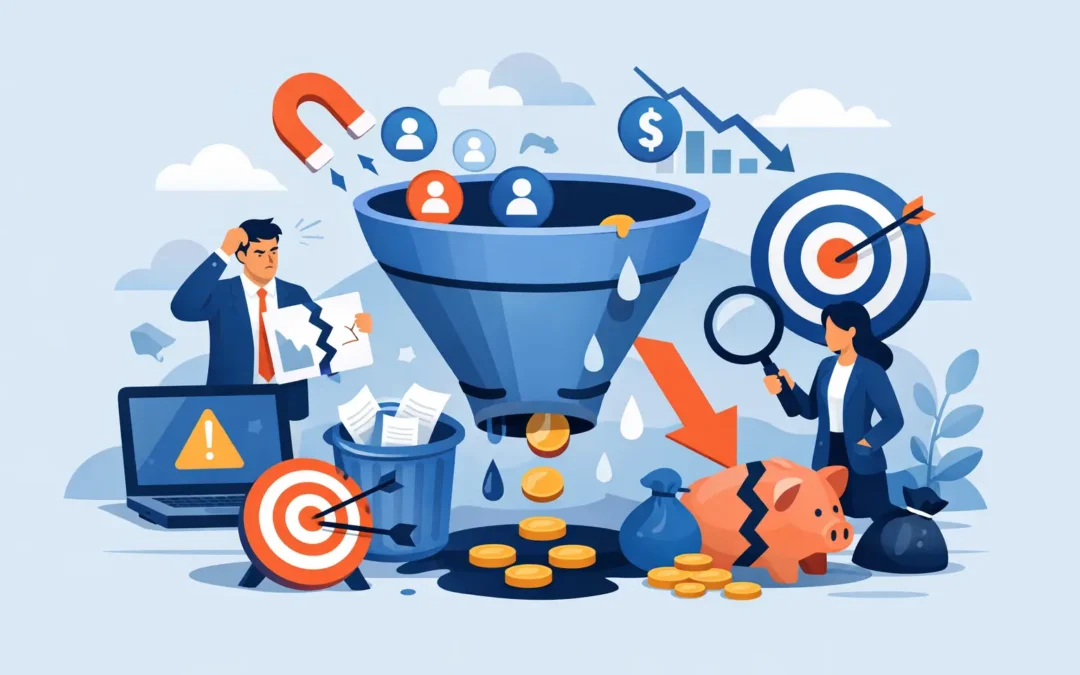
A $35 lead is not cheap when your team spends three days chasing it, reaches voicemail six times, and learns the prospect never had buying intent. That is the real cost behind the top lead generation mistakes: not just wasted media spend, but lost agent hours, slower speed-to-contact, weaker morale, and a pipeline your sales floor cannot trust.
For sales-driven organizations, lead generation is an operating system. Traffic, data, qualification, delivery, follow-up, and attribution all have to work together. When one breaks, close rates fall fast. Here are the mistakes that quietly drain acquisition performance and what to do instead.
The Top Lead Generation Mistakes Start Before Launch
Most lead problems are created before the first form is live or the first call transfer reaches your team. Buyers often focus on volume, then discover too late that the campaign was not designed around the actual sale.
1. Buying volume without defining a qualified opportunity
More leads do not automatically mean more revenue. If sales needs homeowners with a minimum credit profile, a specific debt threshold, a valid insurance need, or an active purchase timeline, those requirements must shape the campaign from day one.
Define qualification in operational terms. Specify geography, product fit, consent standards, contactability, exclusion criteria, and the events that indicate real intent. Then separate what is required from what is merely preferred. Excessive filters can reduce volume and increase cost per lead, but vague standards create a much more expensive problem: agents working prospects who were never eligible to buy.
2. Treating every lead source like it should perform the same
A real-time internet lead, an inbound live transfer, a direct mail response, and an aged record do not carry the same intent, price, or conversion path. Comparing them only by cost per lead gives your team the wrong answer.
Live transfers may cost more upfront but can reduce response-time risk and put a motivated prospect directly in front of a closer. Fresh web leads can scale efficiently if your team can call within minutes. Aged leads can work well for disciplined outbound teams with strong scripts and enough contact capacity. The right channel depends on your offer, margins, staffing model, and ability to follow up.
3. Optimizing for form fills instead of purchase intent
A campaign can generate a cheap cost per lead while producing a weak cost per sale. This often happens when ads, landing pages, or forms overemphasize curiosity, broad savings claims, or low-friction offers that attract people who are not ready to act.
Make the message do some qualifying before the prospect submits. Set clear expectations around the product, eligibility, next step, and timing. Asking one or two useful qualifying questions can raise the lead price, but it may also protect agent time and improve funded deals, issued policies, signed retainers, or completed enrollments. That is a trade worth measuring.
Lead Quality Dies When Speed and Sales Operations Fail
A qualified lead has a short shelf life. The prospect who requested information at 10:02 a.m. may be talking to three competitors by 10:15. Marketing cannot claim success if the lead reaches the CRM quickly but sits untouched in a queue.
4. Letting speed-to-contact become an afterthought
Many teams pay for real-time leads and respond as if they are working a weekly list. That delay destroys the advantage they bought. Assign clear ownership, automate routing, and establish a response-time standard that is measured by lead source, hour of day, and agent.
Speed alone is not enough if the first outreach is generic. The rep should know the campaign, the prospect’s stated need, and the next action expected. If a live transfer is unavailable, an immediate call followed by compliant SMS and a second call attempt can preserve momentum better than one unanswered dial.
5. Sending leads to sales teams that cannot absorb them
Lead flow and call center capacity must match. If marketing can deliver 500 opportunities a day but only a portion receive timely contact, increasing spend will raise waste faster than revenue.
Audit your actual intake capacity before scaling. Look at active agents, calling hours, average handle time, contact attempts, appointment availability, and the number of leads that age beyond your acceptable window. In some cases, the right move is not to buy fewer leads. It is to use live transfers, extend calling coverage, improve routing, or add a trained domestic call center layer that can respond when intent is highest.
6. Blaming leads for weak follow-up discipline
It is easy to label a lead bad after one missed call. In competitive verticals, that is rarely a serious follow-up strategy. Prospects are at work, screening unknown numbers, comparing offers, or simply distracted. Contact rates improve when teams use a consistent, compliant cadence across calls, voicemail, email, and SMS.
Track the number of attempts required to create a conversation and the conversion rate at each stage. If one agent closes leads after eight attempts while another gives up after two, the issue is not just lead quality. It is process control, coaching, and accountability.
Mistakes in Measurement Create Expensive Decisions
7. Judging vendors only by cost per lead
Cost per lead is useful for pacing spend. It is not a profitability metric. A lower-priced source can be the most expensive option if it produces lower contact rates, lower appointment rates, more duplicate records, or poor eligibility.
Compare sources using the full funnel: delivered leads, valid leads, contacts, qualified conversations, applications or appointments, sales, revenue, and margin. Segment the results by campaign, creative, geography, lead age, and sales team. A source that costs 30% more but generates twice the sales is not expensive. It is your growth channel.
8. Failing to close the attribution loop
Media buyers need feedback beyond whether a lead was accepted. They need to know what happened after delivery. Without downstream disposition data, campaigns optimize toward clicks and submissions instead of customers.
Build a clean feedback loop between your CRM, sales operation, and acquisition partner. Standardize dispositions, eliminate vague outcomes such as no good, and capture the reason a prospect did not move forward. Was it unreachable, ineligible, duplicate, outside geography, not interested, unable to verify, or lost to pricing? Specific data gives you something to fix.
9. Changing too many campaign variables at once
When results soften, teams often replace creative, adjust targeting, rewrite the form, change the offer, add a new vendor, and alter sales scripts in the same week. Then nobody knows what caused the improvement or decline.
Test with discipline. Identify the constraint first: lead volume, lead quality, contact rate, qualification rate, close rate, or margin. Change one meaningful variable, allow enough data to accumulate, and compare it against a stable baseline. Fast execution matters, but random optimization burns budget.
10. Expecting a lead provider to repair a broken sales model
A lead partner can improve targeting, screening, delivery speed, and channel mix. It cannot make an uncompetitive offer compelling, force agents to follow up, or fix a CRM that loses records. The best acquisition results come from shared accountability.
Bring your partner the truth: close data, capacity limits, compliance requirements, disqualifiers, and target economics. In return, expect transparency around source, delivery method, lead definitions, replacement policies, and scaling limits. Lead Flow Partners approaches campaigns this way because predictable growth requires more than a lead count. It requires an offer and operation built to convert.
The next campaign does not need a bigger budget to perform better. It needs a tighter definition of quality, faster execution after delivery, and reporting that ties every dollar to a sales outcome. Fix those fundamentals first, then scale the channels that prove they can produce profit.


Recent Comments