
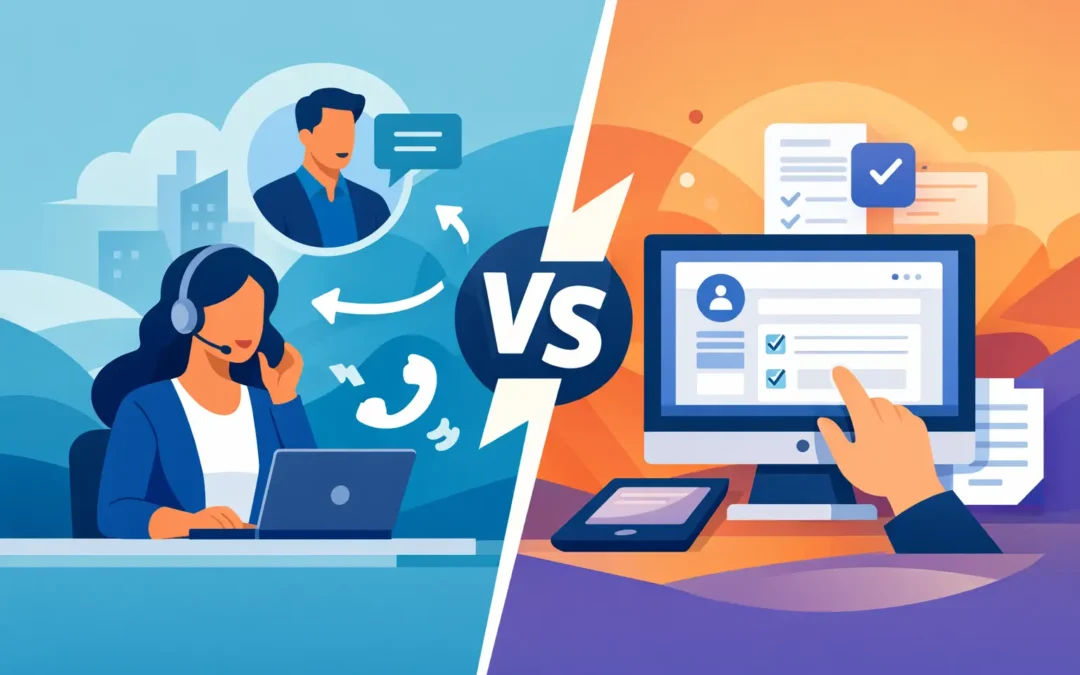
A prospect asks for a quote, checks eligibility, or calls after seeing your ad. What happens in the next five minutes often matters more than the creative, landing page, or bid strategy that produced the lead. That is the real business case behind live transfers versus web forms. One channel puts an interested consumer in front of a sales rep now. The other captures information and puts your follow-up process to work.
Neither format wins in every situation. The right choice depends on your sales capacity, response-time discipline, ticket size, compliance requirements, and ability to turn interest into a completed application or sale. The wrong choice creates a familiar problem: you pay for demand, then lose it before your team makes contact.
Live Transfers Versus Web Forms: The Core Difference
A web form lead is a consumer who submits contact details through a landing page, quote flow, or lead form. Your team receives the information and attempts contact by phone, SMS, email, or a sequence of all three. The buyer controls the follow-up process, but also inherits every risk that comes with it: delayed outreach, incorrect information, duplicate submissions, and declining intent.
A live transfer is an active call connected to your sales team while the prospect is already engaged. Depending on campaign requirements, the consumer may be screened for geography, product fit, credit criteria, ownership status, income, coverage needs, or other qualification points before the call reaches your floor. Your rep starts the conversation when the prospect is available, aware of the offer, and expecting to speak with someone.
That difference changes the sales equation. A web form gives you a record of intent. A live transfer gives you a conversation during the highest-intent window.
Contact Speed Is a Revenue Variable
For high-consideration products such as debt settlement, insurance, mortgage, merchant cash advance, tax relief, legal services, and auto finance, lead decay is fast. Consumers compare providers, get interrupted, second-guess the decision, or simply stop answering unknown numbers. A form submitted at 10:00 a.m. may be materially less valuable by noon if competitors have already called.
Live transfers remove much of that decay. There is no queue for a sales development rep to work through and no hope that a voicemail or first text earns a reply. The prospect is on the phone. Your job is to take control of the conversation, confirm the need, and move toward the next commitment.
That does not mean a transfer automatically converts. A poorly handled transfer can burn budget faster than a form lead. If calls sit in a queue, agents sound unprepared, or the opening does not match the consumer’s expectation, the advantage disappears. Transfer campaigns demand real-time operational readiness, not just a bigger media budget.
Web forms can still perform exceptionally well when your sales operation has fast response standards. Teams that call within minutes, use compliant SMS follow-up, make multiple attempts, and track outcomes by source can turn form submissions into profitable volume. The issue is that very few organizations execute that workflow consistently at scale.
Compare Cost Per Lead to Cost Per Sale
A web form usually has a lower upfront price than a live transfer. That makes it attractive on a dashboard built around cost per lead. But low CPL is not the goal. Cost per funded deal, bound policy, signed client, or completed sale is what determines whether a channel deserves more budget.
Consider a simple scenario. A web form costs less, but only a portion of leads answer the phone and an even smaller percentage reach a qualified conversation. A higher-priced live transfer may generate fewer total records, yet produce more conversations per dollar spent. If the close rate is materially stronger, the transfer can deliver a lower customer acquisition cost even with a higher initial price.
The math should include more than lead price. Account for agent talk time, outbound dialing labor, lead aging, duplicate leads, no-contact rates, compliance review, chargebacks, and the revenue value of a faster sales cycle. In a competitive vertical, speed can also protect margin. Closing a motivated buyer before they collect three more quotes has financial value that does not show up in a CPL report.
Where Web Forms Have the Advantage
Web forms are not a fallback channel. They are often the smarter choice when you need scale, detailed data capture, or lower acquisition costs on prospects who require a longer nurture path.
They work well for campaigns where a consumer needs time to research, gather documents, discuss a decision with a spouse, or evaluate a complex offer. Mortgage, solar, legal, and certain financial services campaigns may benefit from collecting specific data before a specialist engages. A well-built form can pre-qualify the prospect, route them to the right team, and trigger immediate follow-up without forcing a phone conversation too early.
Forms also give marketers more flexibility. You can test messaging, optimize completion rates, capture consent, collect fields that support routing, and build a follow-up audience. That data is useful when your team has a strong CRM, disciplined workflows, and the capacity to work leads across several days or weeks.
The trade-off is simple: form volume does not equal sales opportunity. If a lead sits untouched or enters a generic follow-up sequence, the campaign is feeding your competitors as much as your sales team.
Where Live Transfers Earn Their Premium
Live transfers are strongest when urgency, immediate eligibility, and human conversation drive the sale. They are especially valuable for sales organizations that already have trained closers, defined call availability, and a clear process for moving prospects from initial interest to application, enrollment, or consultation.
Insurance shoppers seeking a same-day quote, consumers exploring debt options, business owners seeking funding, and drivers looking for auto warranty coverage often want answers now. A transfer lets your rep address objections while the reason for the inquiry is still fresh. It also gives the sales team context that outbound dialing rarely provides: the consumer has intentionally requested help and is present for the call.
Transfers can also improve quality control. Campaigns can include qualification rules before connection, such as state availability, age, vehicle ownership, debt amount, business revenue, or product need. Qualification does not eliminate every unworkable call, and vendors should be honest about that. It does, however, reduce the amount of sales labor spent chasing prospects who were never a fit.
The operational requirement is non-negotiable. You need enough agents to answer promptly, clear hours of operation, accurate dispositioning, and a process for overflow. Buying live calls without call-center capacity is like paying for appointments and leaving the office locked.
The Hidden Constraint: Your Sales Team
Channel selection should start with an internal audit, not a vendor pitch. Ask how quickly your team contacts a form lead, what percentage of records become live conversations, how many agents are available by hour, and where calls or leads are being lost. Review close rates by source, not only by campaign. A form lead from one source may outperform a transfer from another if the offer, qualification, or sales handling is stronger.
Then look at your sales motion. If your reps are appointment setters who need to qualify, educate, and schedule a later consultation, forms may provide enough opportunity at a more efficient cost. If your reps are closers who perform best in active conversations, transfers may create better unit economics.
The best answer is often a controlled mix. Use web forms to create scalable top-of-funnel volume and support remarketing or nurture. Use live transfers for high-intent consumers, peak call-center hours, and offers where fast engagement directly improves close rates. Measure each channel against the same revenue outcome, then shift budget based on actual performance.
Build the Right Measurement Framework
Do not let one metric decide the channel. Track form leads from submission through contact, qualification, appointment, application, and sale. Track transfers from connection through talk time, qualification, disposition, application, and sale. This exposes whether a problem sits with traffic quality, lead screening, agent performance, or follow-up execution.
Four numbers deserve constant attention: contact rate, qualified conversation rate, close rate, and cost per sale. For recurring-revenue or high-ticket offers, add retention, cancellation, funded status, and lifetime value. A source that closes quickly but produces weak retention is not necessarily profitable.
Vendor transparency matters here. You need to know lead source, delivery timing, qualification logic, exclusivity terms, geographic coverage, replacement policies, and how duplicates are handled. If reporting stops at delivered leads or connected calls, you cannot make informed scaling decisions.
Lead Flow Partners approaches delivery as a revenue system, combining real-time internet leads and inbound live transfers with the campaign infrastructure sales-driven teams need to evaluate performance beyond surface-level volume.
Choose the Format That Matches the Moment
If your team can answer immediately and close effectively on the phone, live transfers can turn intent into revenue before it cools. If you need broader volume, deeper intake data, and a nurture process your team can execute quickly, web forms can produce efficient pipeline at scale.
Do not buy either channel because the lead price looks attractive. Buy the channel your operation can convert, measure it against closed revenue, and fix the handoff before adding more spend. The prospect has already raised their hand. Your advantage comes from what your team does next.


Recent Comments