
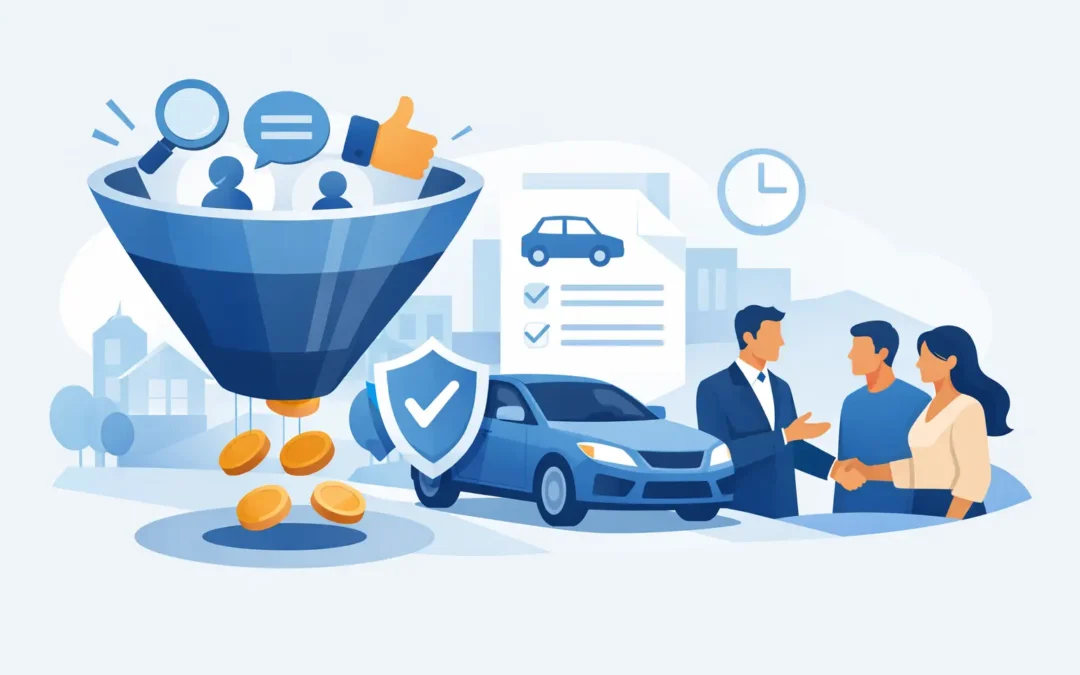
A shopper submits an auto insurance form at 10:02 a.m. By 10:15, they have already compared carriers, received three calls, and may have chosen the first agent who delivered a clear quote. That is the reality behind auto insurance lead funnels: the winner is rarely the company with the most leads. It is the company that captures genuine buying intent, responds immediately, and moves the prospect to a quote without friction.
For agencies, call centers, and lead buyers, a funnel is not a landing page followed by a lead notification. It is the full operating system behind acquisition – traffic source, qualification, compliance, routing, contact strategy, agent availability, and conversion tracking. Every weak handoff raises acquisition cost. Every fast, relevant conversation improves the odds of binding business.
What High-Performing Auto Insurance Lead Funnels Do
A profitable funnel has one job: turn consumer demand into live, qualified sales opportunities at a cost the buyer can support. That requires more than cheap form submissions. A low-cost lead that cannot be reached, does not meet carrier requirements, or is shopping only for a theoretical price is not an efficient acquisition.
Strong funnels separate curiosity from purchase intent early. The consumer should understand that they are requesting insurance options, quotes, or a licensed agent conversation. The questions should collect enough information to establish fit without creating a long, exhausting application before a real person can help.
The right balance depends on the delivery model. Real-time internet leads can support higher volume and broader agent outreach, but they require aggressive speed-to-lead and disciplined follow-up. Inbound live transfers usually cost more because the consumer is already engaged and ready to speak, but they can eliminate the contact-rate problem that drains performance from standard form leads. Direct mail can produce a different buyer profile, particularly when the offer and call handling are aligned. There is no universally superior channel. There is only the channel that produces profitable policies for your sales operation.
Build the Funnel Around Buyer Intent
Start with the offer. “Compare auto insurance rates” may generate volume, but it also attracts shoppers at every stage of the decision cycle. A more direct offer, such as a personalized coverage review or an opportunity to speak with an agent about lowering a current premium, can set clearer expectations. The trade-off is simple: tighter positioning may reduce lead volume while improving lead quality.
Your landing page or call flow should reinforce that expectation. Keep the message focused on the outcome the consumer wants: a quote, coverage options, potential savings, or help finding a policy that fits their situation. Do not bury the next step under generic claims or unnecessary content.
Qualification fields should support sales, not satisfy curiosity. Ask for the information agents need to prioritize and quote efficiently, such as ZIP code, vehicle details, current coverage status, household information, and contact preference. If a lead buyer has strict underwriting criteria, filter for those conditions before delivery whenever possible. A campaign that sends nonviable prospects to agents is not scaling. It is shifting waste downstream.
Consent language also needs to be clear and visible. Auto insurance campaigns often use phone, SMS, and transfer-based follow-up. The consumer must understand what they are agreeing to and how they may be contacted. Compliance is not a last-minute legal checkbox. It protects deliverability, campaign continuity, and the value of the lead supply.
Speed-to-Lead Is a Revenue Lever
Once a prospect raises their hand, the clock starts. Contact rates decline quickly when outreach is delayed. A consumer who was ready to compare coverage a few minutes ago may be busy, distracted, or speaking with a competitor by the time the first call arrives.
For internet leads, connect attempts should begin immediately. If your team cannot consistently call new leads within minutes, do not solve the problem by buying more leads. Fix routing, staffing, and alerting first. A reliable sequence of calls, compliant SMS outreach, and email follow-up will outperform a single attempt from an overloaded agent.
Live transfer campaigns change the equation. Instead of asking agents to chase a form submission, the campaign qualifies the consumer and connects them while attention is high. This can create better conversations and faster quote activity, especially for teams built to answer calls in real time. The trade-off is capacity. If agents are not available when transfers arrive, the premium paid for live intent disappears fast.
Route Leads Based on the Ability to Close
Sending every lead to the same queue is easy. It is also expensive when different agents, locations, and partners have different appetites, carrier access, schedules, or close rates.
Lead routing should reflect the economics of the sale. A high-intent shopper with complete information may deserve immediate priority routing. A prospect requiring additional qualification may enter a different nurture path. States, ZIP codes, vehicle types, coverage needs, and time of day can all affect which buyer or agent is best positioned to convert the opportunity.
The most useful routing logic is practical, not complicated. Route based on availability, licensing, buyer criteria, and demonstrated performance. Then monitor outcomes. If one team produces stronger contact rates but weak bind rates, the issue may be sales execution. If another team binds well but receives too few qualified opportunities, the issue may be allocation. Funnel data should expose those gaps quickly.
At Lead Flow Partners, this is why delivery options matter. Real-time leads, inbound transfers, targeted data, and campaign support are not interchangeable products. They give buyers room to build a lead mix around agent capacity, acquisition goals, and the point where a lead becomes profitable.
Measure the Funnel Beyond Cost Per Lead
Cost per lead is a buying metric, not a complete performance metric. It can hide the difference between a campaign that fills a CRM and a campaign that creates written premium.
Track the full path from source to policy. At minimum, measure lead volume, speed-to-lead, contact rate, quote rate, bind rate, cost per quote, cost per bind, and revenue or commission per policy. Break these numbers down by source, creative angle, state, agent group, and delivery time. Patterns become obvious when the data is specific.
For example, a source with a higher cost per lead may produce the best cost per bind because prospects answer the phone and carry stronger purchase intent. Another source may look efficient until follow-up costs and low contact rates are included. The right decision is based on net conversion economics, not the cheapest number at the top of the funnel.
Sales feedback needs to return to media and operations quickly. If agents repeatedly report that a source produces consumers seeking only minimum coverage, that insight should shape targeting and messaging. If leads convert well after 6 p.m. but call attempts slow down at that hour, staffing should change. The funnel improves when media buying, call handling, and sales management operate from the same scorecard.
Fix the Leaks Before You Add Volume
When results drop, the temptation is to blame lead quality. Sometimes that is correct. Often, the lead is being lost after delivery.
Look first at response time, unanswered transfers, duplicate handling, agent availability, and follow-up consistency. Review calls and dispositions. “Not interested” can mean the prospect was genuinely unqualified, but it can also mean the agent called too late, failed to establish value, or could not quote the risk effectively.
Then look upstream. Match lead volume to the hours your team can handle it. Cap delivery when capacity is limited. Exclude segments that repeatedly fail your profitability test. Test one meaningful variable at a time – offer, source, form length, qualification logic, or routing rule – so you can identify what actually changed performance.
A funnel should not be treated as a one-time build. Auto insurance demand shifts with rate increases, renewal cycles, carrier appetite, and competitive pressure. The operations that win are the ones that protect speed, measure every handoff, and keep improving the path from inquiry to policy.
The next opportunity is only valuable if your team can reach it, quote it, and close it before someone else does. Build your funnel around that reality, and lead volume becomes a controllable growth engine rather than a monthly expense.


Recent Comments